

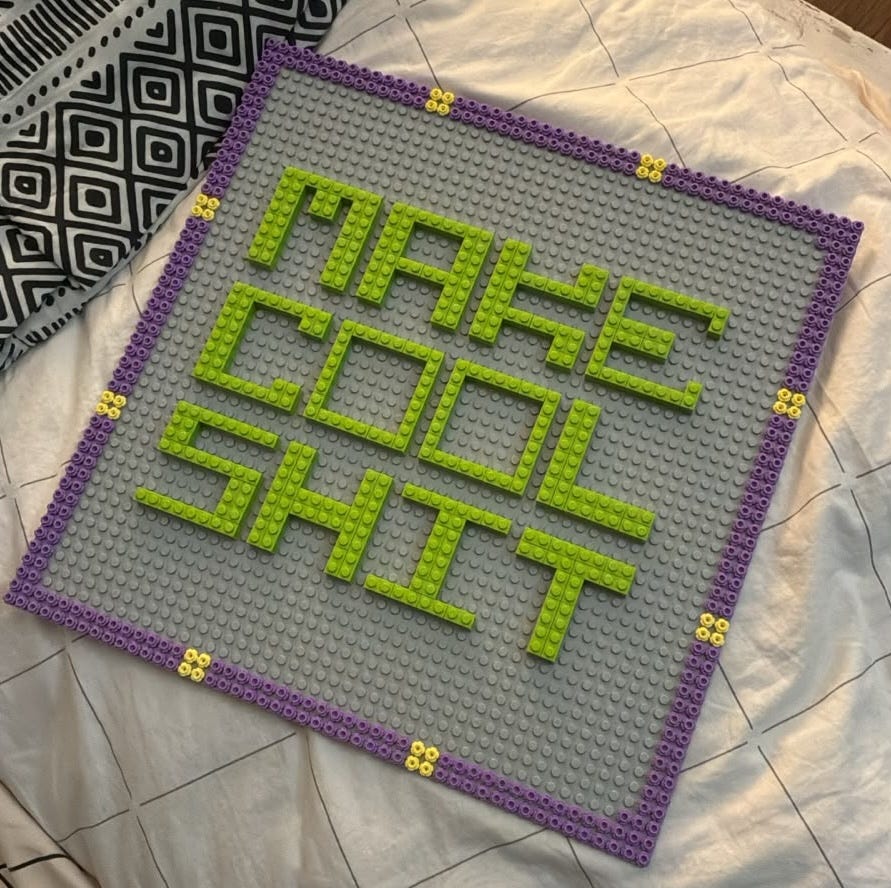
I found myself at the LEGO store recently, and saw in the play area that someone had used the bricks to write “JOHN CENA”. This gave me the idea that I could use LEGO to write short messages, and maybe that could be wall art for my room. I spotted the perfect canvas for it, and a vision started to form in my head.
There were a few hurdles. First there was the cost: The baseplate itself cost INR 1599, and I could not estimate how many bricks I’d need to write phrases on the plate. For INR 1100 more, I had the option to grab as many LEGO bricks I could fit into a tiny box, but I didn’t know if I would get enough to write anything, in which case I would have to possibly buy another tiny box. Was I diving into an expensive project with a child’s temptation and the poor planning that comes with it?
Second there was the fear of stupidity: I could go home and try to create what I had in mind only to discover I didn’t have enough bricks, or that some letters could simply not be written using the LEGO pieces I had picked up. I was pacing the store trying to ensure that I wouldn’t end up doing something stupid. The conclusion from failure in this case was wasted money and a hit to my self-esteem, having tried something and ended up not being effective at it.
Hamza said it could end up looking really cool, and that was enough motivation for me to take the leap. I stressed about which bricks to pick up and tried to fit as many of them as I could into the tiny box, and finally made the purchase. Then, in between the hours between making the purchase and being home to unwrap it, I stressed about whether it would all come together or I was just being stupid.
Finally, when I came home and started putting it together, it came together better than I could have imagined. I was so thrilled, and part of what made it special was the risk involved. I had ventured into the unknown in my own small way, risked feeling stupid and wasting money, and come out on the other end victorious! Here, friends, was the end result:
Fear of Waste
The fear of wasting is predicated on the ideal that all consumption must be intentional and certain. You should buy only books you know you’re going to read, or the number of bananas you can reasonably consume within the week. You shouldn’t buy oil paints unless you’re sure you’re going to get up to any good with them. To this date, I am afraid of buying a serious canvas and using serious paints on it lest I mess up and it all goes to waste.
Creative work is incompatible with the zero-waste ideal, because it is necessarily uncertain. You don’t know if you’ll have enough LEGO bricks, if the painting is going to look good, if the recipe will turn out tasty. Not knowing means risking waste, but it is a necessary step to having the shot at creating something good. Anthony Bourdain was writing about the same thing with this sentence: “Don’t be afraid to eat a bad meal. You know, if you don’t risk the bad meal, you’ll never get the magical one.”
Sanya and I have an accident budget we create each time we travel to give ourselves a buffer against uncertainty and ensure that unforeseen experiences don’t make our trips stressful. I am wondering now if a creativity budget is also in order, to give myself permission to try things and fail at them.
Recently, I have been learning how to work with Tofu. I made Tofu Broccoli and threw half of it away. I made Tofu Chocolate Mousse and threw all of it away. I found out what I did wrong in both cases, and I bet my next iterations are going to be promising. I don’t think I could have arrived at the good versions of these things without first going through the bad versions. There is popular advice about writing that says “You have to write the bad sentence first to arrive at the good sentence,” and I am starting to discover that it applies to more than writing.
Waste and Writing
I have been writing a lot recently, and I’m so grateful that paper is no longer the only medium for it, because I would feel terribly guilty about the trees. Most of the writing is so bad that the tree in its afterlife would look at me, disgusted. “This is the nonsense I had to die for?” it would say. What has helped me to write consistently these days is to adopt the mindset that waste is the most likely result. The odds that I will write something that is worth showing other people are, on most days, terribly low.
What was terrifying with writing before was confronting the realization that I am not actually the best writer the world has ever seen. It was as though the moment I typed something out, it became real. Treating most of my writing as waste already, before anything has even been written, has freed me to do it more lightly. Of course, in that process of creating more and more waste, a couple sentences here and there start to seem redeemable, start to seem like maybe they don’t belong in the bin.
There is, of course, the sustainability angle in all this, but somehow I think we feel the most guilty when creating waste in creativity and unproductive endeavors. At work (especially in marketing), it is a given that some part of the budget will be wasted in campaigns that don’t work. While intentional and sustainable consumption is a serious and important thing to wrestle with, in my mind its presence being felt most urgently in small creative projects is misplaced. What could I come up with if I allowed myself to waste more?